





 Back
Back

 Book a meeting
 Book a meeting


How the FT is rethinking audience engagement through format innovation
Q&A with Hannah Sarney
Sean Kearns, Strategy and innovation director View Sean’s profile


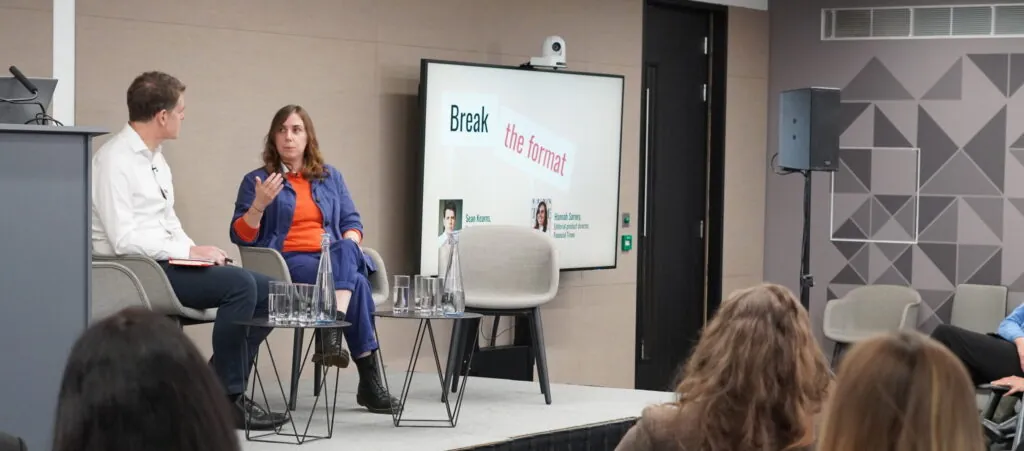
At FT Longitude’s recent event on the future of thought leadership and the insights industry, strategy and innovation director Sean Kearns was joined by Hannah Sarney, editorial product director at the Financial Times, to discuss the art of audience engagement.
Sean: Right now, we live in the attention economy, where audience attention spans are a scarce commodity. How does this frame your approach at the FT, Hannah?
Hannah: There is certainly a war on time these days. The FT is obviously up against other publications, but we’re also competing for attention against the likes of Spotify and Instagram.
A key question for us at the moment: how do we grow the reach and impact of our journalism? Audience attention is being pulled in so many different directions by incredibly enticing spaces – ones that often require less effort from the audience.
The answer lies in innovation – finding new formats to engage our audience. Still, it can be very difficult to squeeze those innovative efforts into our existing workload. Staff are already facing their own war on time, especially the FT’s editorial team, as they are under a lot of time constraints with the news agenda.
The newsroom works at a rapid pace, running on a 24-hour cycle. We have a print deadline at the end of every day and minute-by-minute digital deadlines. So, when it comes to innovating to find new formats, there is a natural tension between the pace of the newsroom and the work cycles of product development teams.
A big focus for us is finding practical ways to foster a new cultural mindset so the collaboration between the cross-departmental teams is a bit closer to the rhythm of the news agenda.
With that context in mind, it would be fascinating to hear about any processes that have been fruitful for format innovation at the FT.
In the audience engagement space, we’re finding success with running what we call tiny experiments. Rather than immediately diving into extensive software development, we do a quick build of an idea and see if it works. The build won’t be maintained unless it really proves its worth. If it does, then we can upgrade it and roll it out further.
To do that, one part of the product and tech team is embedded in the newsroom. They’re working with editors, understanding the news flow and trying to pull these builds together in days or weeks rather than months.
One crucial success factor here is: no matter how tiny the experiment is we must have a very clear view of its aim, objectives and success metrics. Skip any of those definitions and the end of the experiment can devolve into a subjective debate about the success of the experiment.
Has the tiny experiment approach generated any standout wins with format innovation at the FT this year?
My favourite way of describing how the tiny experiment model works is thinking of it as a dance floor and balcony set up. You’ve got the dance floor, which has lots of tiny experiments running at the same time, it’s great fun. The newsroom is pretty much always on the dance floor. We’re looking at each other and we’re trying out different moves. But where we’ve been really successful is when we have someone observing the dancefloor from the balcony. They provide a clear sense of how each tiny experiment fits within the broader landscape of what our editorial team is trying to achieve and our overarching business strategy.
The example from this year that comes to mind is a feature I’m really proud of: Ask an Expert. It’s not revolutionary in terms of its core concept. It allows subscribers to ask a question of one of our FT experts. But the reason why I love it is that it feeds into so many of our business goals.
We have a big focus on building habits with our subscribers. We know that readers who read and write comments are 47 times more engaged than those who don’t. If they just read comments, they’re 11 times more engaged. However, it is a small subset of our base who get into the comment writing space. So one of our objectives is to bring more people into that space. According to our research, one barrier to entry is that readers worry if they comment they’re going to get piled on and critiqued by other readers’ in their comments, even though we moderate to the best of our ability.
more engagement from FT users that read and write comments
more engagement from FT users that just read comments
Ask an Expert provides a safe, controlled space where subscribers can discretely get answers to their questions without having to debate with other subscribers. It also provides readers with direct access to the Gideon Rachmans and the Martin Wolfs of the world. We’re elevating subscribers on to the same platform as FT experts.
From a product design and development perspective this feature is unlike anything we’ve done before. It’s got a live state, which typically runs for about an hour, and a closed state for those who need to catch up afterward. The user interface provides a unique experience when compared to the standard FT article. The brief I gave to our product designers was, in simple terms, ‘fun and bold’. Our brilliant designers were able to create an Ask an Expert interface that feels a bit more like a chat with light animation coming through it.
We’ve pushed the boundaries a bit, but there’s still so much more we want to do with the Ask an Expert feature. Nevertheless, it’s currently working well. Every live session is bringing in sizeable numbers of subscribers who’ve never commented before, so they’re setting up profiles just to get involved. We’re genuinely bringing new voices into the conversation with our journalists.
For the full recording of this session and more from our experts about breaking the format in thought leadership and B2B marketing register here to watch the webinar.
Thought leadership? Think Again, Bracken House, 19 November 2025
Sign up to the newsletter
We help organisations stand out, speak with authority and spark inspiration, so change can happen. That’s real intelligence with influence. Sign up to our newsletter to get regular updates.
Subscribe