





 Back
Back
 Book a meeting
 Book a meeting


Built to last: How influential brand platforms grow over time
The most recognised and referenced thought leadership campaigns are designed to compound
Joe Newman, Senior campaign strategist View Joe’s profile


Too much thought leadership is still planned as a publishing exercise. Whether it’s a major annual report, an event launch or another burst-style release, the formula stays the same. A quick loud bang and then a slow fade out of relevance.
The hard truth is that genuinely impactful thought leadership campaigns aren’t designed to peak in their first year.Yes, they should be built for early impact, but the most effective programmes are designed to stay relevant in year five, ten and beyond.
When brands stop treating thought leadership as one-off outputs and start designing them as long-term assets, they become increasingly hard to ignore. This shift in mindset creates something repeatable and recognisable.
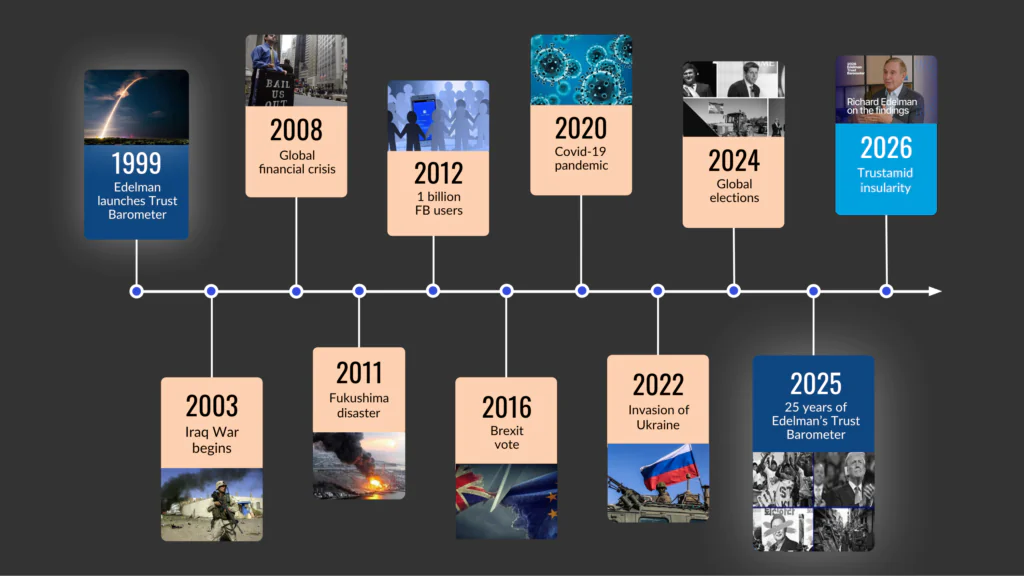
Think of Edelman’s Trust Barometer. What could have been a one-and-done campaign when it launched in 1999 has become a renowned and respected platform for insights – something clients, journalists, analysts and internal stakeholders anticipate, reference and use.
So how can more brands replicate this ‘magic’?
In this article we dig into our analysis of almost 300 thought leadership campaigns, revealing how longevity and consistency earn brand authority and create the conditions for stronger performance over time.
Long-term brand strategy is critical
There is a tendency among marketers to treat longevity as a byproduct of success. A campaign that performs well gets repeated. But the correlation between longevity and success goes deeper than that. Repetition and familiarity is a big part of what creates impact.
The average age of the 50 most influential thought leadership campaigns we analysed was a little over 15 years. This means that the most powerful brand platforms have survived changes in company leadership, business cycles, crises, trends and shifts in audience attention.
is the average age of the most influential thought leadership campaigns
That is a striking number on its own. But its significance becomes even clearer when set against the volatility of the environments these campaigns have lived through. In that time, companies and brands have had to navigate financial shocks, pandemics, geopolitical fragmentation, digital transformation and the rise of AI.
While there is almost certainly some level of survivorship bias at play here, the fact remains that the campaigns that stand the tests of time are not static. They stay recognisable while evolving their framing, applications and formats around a stable core proposition.
Key takeaway: The best thought leadership platforms are stable in their topic and flexible in their perspective.
The five-year tipping point for brand platforms
Our analysis of nearly 300 recent thought leadership campaigns reveals a clear tipping point at five years. Up to that point, performance builds steadily; beyond it, results accelerate. Campaigns running for five years or more achieve a pronounced multiplier effect across measurable outcomes.
That multiplier shows up in three important ways.
1. Older campaigns perform better in the media
Campaigns of more than five years earn more tier-one media mentions and greater total media reach than newer entrants.
more tier-one media mentions
greater total media reach
2. Older campaigns are stronger at creating conversation
Mature platforms generate a higher number of mentions on social media and in online forum. The battleground for influence is no longer limited to coverage or owned channels.
more social media mentions
more forum mentions
3. Longer-running campaigns build organic authority.
After five years, brands attract more audiences actively searching for their thought leadership, increase organic traffic, and earn more high-authority backlinks.
Attention matters, but it isn’t the end goal. Crucially, our analysis shows that as campaigns mature, they convert that attention into sustained impact.
active campaign searches
estimated organic traffic
high-authority backlinks
Key takeaway: The strongest thought leadership platforms show a clear multiplier effect after five years.
Why campaign performance compounds over time
Knowing that older campaigns tend to outperform newer ones is useful – but it doesn’t explain why.
The answer lies in momentum. Campaigns that demonstrate value early are far more likely to secure ongoing backing. Once a programme proves it resonates – whether through lead generation, brand impact or audience engagement – it builds confidence internally.
That confidence creates a virtuous cycle. Strong performance unlocks further investment, giving marketing teams the headroom to refine the experience, diversify the content mix and explore new channels.
Over time, this is what sets the best campaigns apart. Longevity brings permission to evolve. Rather than repeating the same formula each year, successful programmes expand, building on what works and pushing into new territory, allowing established programmes to evolve from single annual reports into full ecosystems.
Key takeaway: The best thought leadership platforms evolve from reports to platforms for insight.
The three things enduring brand platforms get right
The standards for excellence in thought leadership continue to rise. Marketing teams producing high-quality, engaging and widely distributed content may see themselves as the gold standard.
But even strong programmes can fall short. Many miss the ingredient that distinguishes the most successful long-running campaigns: usefulness.
It’s this, more than production value or reach. that earns sustained attention and keeps audiences coming back over time.

Using a stable methodology allows users to make a meaningful comparison across years, giving them confidence that the business providing them with insights is tracking change rather than chasing novelty. That’s why enduring brand platforms are built around consistency in method and freshness in perspective.
The key to ensuring that a thought leadership programme remains relevant is balance. Change too much and you lose credibility; don’t change enough and your insights risk becoming stale.
That’s why we recommend the 25% refresh rule. Keep the core methodology intact, but update around a quarter of the programme each year to reflect the issues shaping the current market agenda.
Using a stable methodology allows users to make a meaningful comparison across years, The best brand platforms don’t just explain a complex topic, they help business leaders and decision makers navigate uncertainty around that topic.
That means giving audiences something practical they can use – whether that’s benchmarks, decision frameworks or clear, actionable recommendations for moving forward.
Done well, this has tangible commercial impact. Being seen as a trusted advisor can make the difference between winning new business and losing it.
Strong platforms are launched with intent and backed by recognisable advocates who can communicate their value with clarity. Internal alignment is critical to landing the message and ensuring audiences understand why it matters.
One effective way to anchor a campaign is through a signature measure: something distinctive and memorable at its core. This could take the form of a score or index designed to generate conversation and coverage.
But its value goes beyond visibility. A strong signature measure gives commercial teams a clear entry point, providing a simple, credible way to open conversations with prospects.
Consistency also matters. When audiences know when to expect new insights, launches can become fixtures in the calendar, building anticipation and, over time, momentum of their own.
Examples of effective brand platform design
PwC’s Global CEO Survey
Few campaigns demonstrate the power of consistency as clearly as PwC’s Global CEO Survey. Now approaching its third decade, it has moved far beyond being a flagship report. It has become a reference point for how global business leaders are thinking — and a recurring moment in the corporate calendar.
Its strength lies in how deliberately it balances scale with relevance.
At its core is a stable, repeatable research engine: a large-scale annual survey of CEOs. That consistency creates a reliable trendline, allowing the campaign to track shifts in sentiment over time. But what keeps it fresh is the way each edition reframes the findings around the most pressing issues of the moment — whether that’s digital transformation, ESG, geopolitical uncertainty or AI.
Crucially, the platform is designed to travel.
Rather than presenting a single global narrative, it is structured to be interpreted and activated across regions and sectors. Local leaders and partners are empowered to extract the most relevant insights for their audiences, turning a centralised dataset into a distributed storytelling engine. That internal advocacy is a major driver of reach — and it only becomes possible once a campaign has been embedded over time.
The format has evolved in parallel. What began as a report is now a full ecosystem: live launches aligned to major global events, short-form audio and video, leadership commentary and social amplification. The insight is no longer confined to a PDF; it is carried by people, formats and conversations.
This is what institutionalisation looks like in practice. The campaign is not just published — it is performed, shared and expected.
Edelman’s Trust Barometer
If PwC’s platform is built on scale and consistency, Edelman’s Trust Barometer shows the power of conceptual ownership.
For more than two decades, it has focused on a single idea: trust. That simplicity is its strength. By anchoring the platform to one word, Edelman has created something both highly distinctive and endlessly adaptable.
The key is that “trust” is narrow enough to be ownable, but broad enough to be applied almost anywhere.
It can flex to examine trust in institutions, business, government, media or technology. It can respond to the issues of the day — from political leadership to AI — without losing coherence. The methodology remains stable, but the lens shifts with the agenda.
That flexibility is what allows the platform to stay relevant year after year, without becoming fragmented.
The campaign also makes intelligent use of its own history. By linking findings to previous editions and major global events, it reinforces the idea that this is not just a snapshot of current sentiment, but a long-term record of how trust evolves. That continuity builds credibility — not just in the data, but in the platform itself.
Importantly, the insight does not stop at measurement. The campaign consistently translates findings into clear implications for organisations, often framing what businesses should do in response. This makes the output more than informative; it becomes directive.
Over time, the result is a form of authority that goes beyond data. Edelman has gone beyond tracking trust and has become synonymous with it.
Different models for success
Taken together, these examples show that there is no single formula for building a long-running thought leadership platform. One is built on survey data at global scale, the other on conceptual ownership. However, the underlying pattern is the same. Both campaigns:
- have a stable core that creates continuity.
- evolve their perspective to stay relevant.
- turn insight into something usable.
- have been given the time to compound.
That is ultimately what sets enduring platforms apart. They are not just designed to say something interesting once. They are designed to become more valuable every year they exist.
About the authors

Joe Newman
Senior Campaign Strategist, FT Longitude
As a campaign strategist, Joe makes sure our campaigns deliver maximum impact and meet client goals. From competitor analysis and theme development to activation and measurement, he ensures the right content reaches the right audience at the right time.

Hannah Freegard
Deputy Editorial Director, FT Longitude
Hannah crafts thought leadership content that helps FT Longitude’s clients boost their reputation and uncover new opportunities. Whether it’s in-depth reports or eye-catching infographics, she makes complex topics engaging and easy to understand.
Sign up to the newsletter
We help organisations stand out, speak with authority and spark inspiration, so change can happen. That’s real intelligence with influence. Sign up to our newsletter to get regular updates.
Subscribe